Have you read the Epic of Gilgamesh?
Ngl, it's pretty epic.
What could I possibly learn from two-thirds divine and one-third human ancient king who lived four thousand years ago? Turns out a lot.
HUM 111 Cultures Civilizations and Ideas I, and HUM 112 Cultures Civilizations and Ideas II. These two mandatory courses I took in collage irrevocably changed the way I think, feel, understand... We were assigned to read literary texts of ancient societies, the first one was The Epic of Gilgamesh. Little did I know, it was going to change the way I see life. It’s an epic story with so much details, but I will skip a lot to get to my point. Which is still a very long summary because I can’t shut up.
Gilgamesh is the king of Uruk, two-thirds divine and one-third human. He is an ancient toxic masculine bro: a tyrant, a rapist etc. The people of Uruk cry to Gods to help them. Gods respond and create Enkidu.
Let him be a match for the storm of his heart, let them vie with each other, so Uruk may be rested.
Enkidu is a wild animal man(tarzan one might say), covered in hair. A woman named Shamhat, a sacred temple prostitute, is sent to tame him. Back in those days people would have sex to purify themselves. It was a form of religious act. Which sounds jarring at first but I agree. Sex is an act that reaffirms our self worth, thus its purifying.
Shamhat and Enkidu make love for six days and seven nights, which transforms him from a wild beast into a man. Surprisingly relatable experience. I have been civilized by touching biceps for the very first time myself.
Enemies to lovers type of trope happens betweeen Enkidu and Gilgamesh. Enkidu hears about Gilgamesh sleeping with brides on their first night and gets really angry, starts a fight with him. During the fight when Gilgamesh realizes finally there's an equal to his powers and strength, they decide to become friends. We are all looking for us in others after all... Even ⅔ divine doesn’t change that huh?
The 'friendship' teaches Gilgamesh having something to lose. When Enkidu dies Gilgamesh clings to Enkidu's body and denies that he has died until a maggot drops from the nose of the corpse. Gilgamesh grieves by roaming the wild wearing animal skins. Having now become fearful of his own death, he decides to seek Utnapishtim, and learn the secret of eternal life. Utnapishtim is an ancestor of Gilgamesh, a mortal that was given eternal life. He reprimands him, declaring that fighting the common fate of humans is futile and diminishes life's joys. Carpe diem, YOLO, call it what modern name you want.
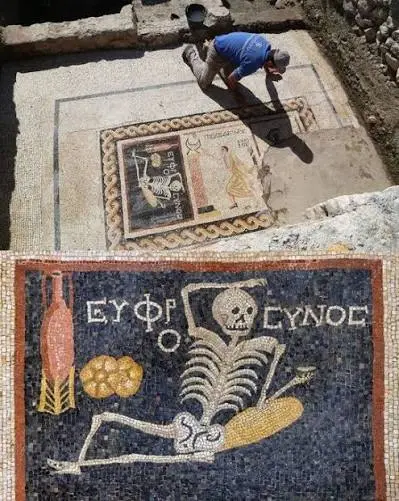
One of my favorite mosaic from Hatay, Turkiye. Dated back to 4 BC. a skeleton with a drinking vessel in his hand along with bread and a wine pot, with the words, “be cheerful and live your life.”
Utnapishtim immortality story(the flood) is my favorite part of the epic. Brevity of human life is conveyed through this line:
Ever the river has risen and brought us the flood, the mayfly floating on the water. On the face of the sun its countenance gazes, then all of a sudden nothing is there.
Adult mayflies have just a few hours before they die. If we are lucky we can live up to 80-90 with good health. Maybe even 100. Our 100 years of life isn't even a milisecond in the vastness of time and space. We are tiny little mayflies. Here only briefly.
Utnapishtim challenges Gilgamesh to stay awake for six days and seven nights. Gilgamesh, who is seeking to overcome death, cannot even conquer sleep. Utanapishtim then tells Gilgamesh about a plant that can make him young again. He finds the plant from the bottom of the sea, only for a serpent to steal it. Having failed both chances, he returns to Uruk. The sight of Uruk’s massive walls provokes him to praise this enduring work of mortal men. Mortals can achieve immortality afterall, through lasting works of civilization, art, and culture.
Around four thousand years ago an epic was written. It was about two-thirds divine and one-third human ancient king who was looking for immortality. At the end of the epic he died. And today I'm writing about him, talking about him.
He found immortality he was searching for.